Proven Social Media Tips to Drive Sales for Small Businesses
How Social Media Management Actually Drives Sales: Turn Followers into Customers with Strategic Marketing

Social media management that’s built for sales uses targeted content, audience signals, and conversion mechanics to move followers from passive scrolling to paying customers. This piece explains how strategic social marketing differs from random posting: we define revenue-focused metrics, map a conversion funnel, and outline the organic and paid tactics that reliably generate leads. Too many small businesses mistake likes for demand—wasting time and budget. Here you’ll learn the specific mechanisms that link social activity to revenue and the measurement approaches that prove impact. The guide walks through why social works beyond vanity metrics, a step-by-step sales funnel, the content and ad tactics that win leads, social commerce best practices, and a practical measurement framework for ROAS, CAC, and CLV. It also shows how a managed service like Five Day Solution executes these steps so business owners can focus on operations while their social channels produce measurable sales. By the end you’ll have a concise checklist and comparison tools to plan and measure social-driven revenue.
Why social media marketing drives sales beyond likes
Social media moves the needle because it builds trust, sends targeted traffic, captures prospects, and enables conversion through retargeting and in-platform commerce. Engagement creates familiarity and social proof, making people more likely to click through to product pages or opt into an offer. Paid targeting and retargeting turn interest into transactions by layering creative cues and audience signals to reach people ready to buy. When you understand these mechanisms, you stop chasing vanity numbers and start allocating time and budget to activities that produce measurable revenue.
Impressive-looking social metrics often hide weak purchase intent; shifting to conversion-focused KPIs corrects that. The next section explains which vanity metrics mislead and which sales measurements deserve your attention.
What are vanity metrics and why they don’t drive sales
Vanity metrics are surface-level numbers—likes, follower counts, and broad impressions—that indicate attention but not intent to buy. They fail because wide reach can lack relevance, engagement can be passive without a clear CTA, and follower totals rarely equal an active customer base. A viral post that links to an irrelevant landing page wastes momentum and lowers conversion odds. To change outcomes, prioritize metrics tied to action—clicks, leads, add-to-carts, and purchases—so your creative and targeting choices directly support revenue goals.
Reorienting measurement priorities leads into defining sales-driven social and the KPIs that make attribution meaningful.
How sales-driven social media is defined and measured
Sales-driven social is activity designed explicitly to create measurable revenue through traffic, leads, and conversions, not just awareness. Measure it with conversion rate, customer acquisition cost (CAC), return on ad spend (ROAS), and customer lifetime value (CLV)—each one connects social actions to dollars. Conversion rate is conversions divided by clicks; CAC is marketing spend divided by new customers; ROAS compares revenue to ad spend; CLV projects revenue per customer over time to guide retention investment. These metrics steer strategy by showing which audiences, creatives, and funnel stages actually produce sales instead of surface engagement.
With these metrics in place, you can build a practical funnel that moves audiences toward purchase with measurable checkpoints.
How to build a social media sales funnel that converts
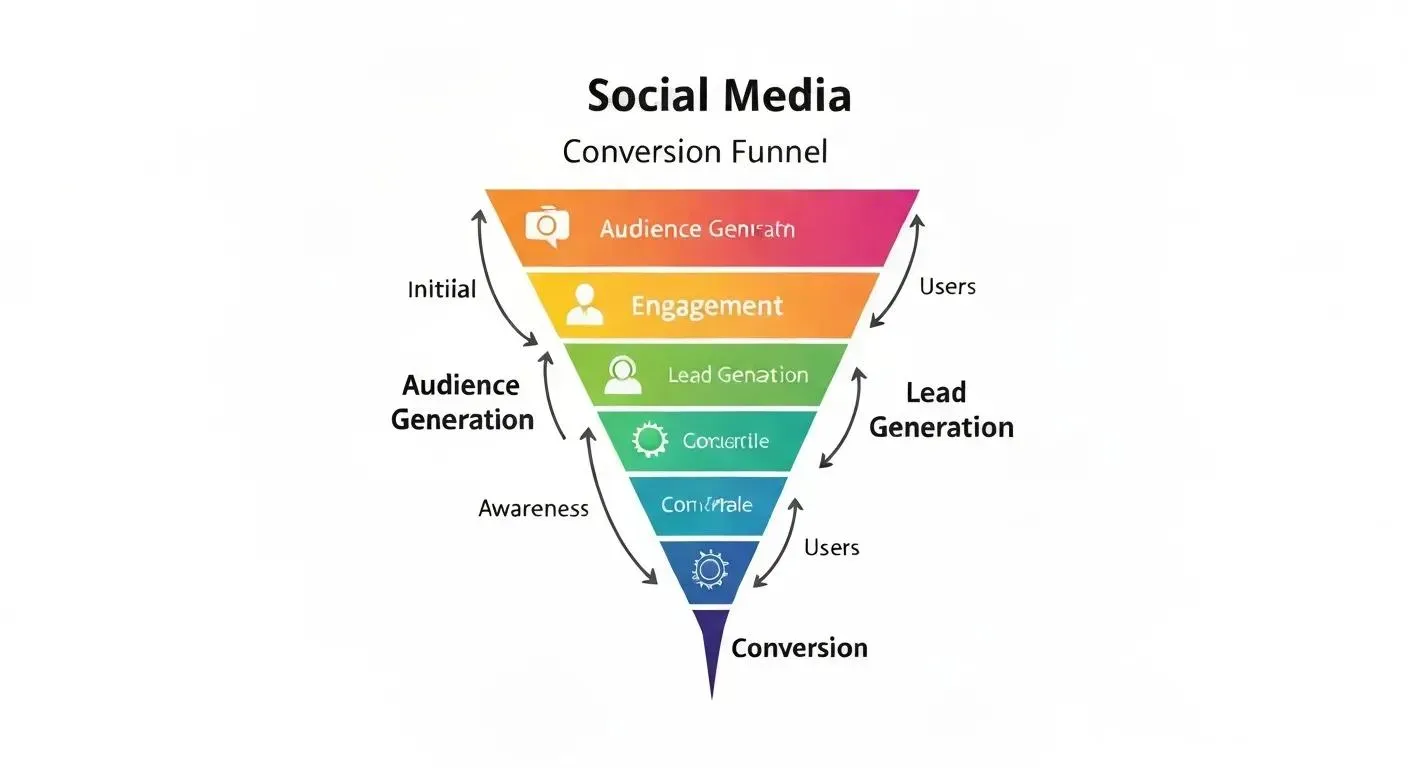
A converting social funnel guides people through Awareness → Interest → Consideration → Conversion → Retention using tailored content, precise targeting, and clear measurement at each stage. At Awareness you attract the right prospects with targeted creative and audience research; Interest nurtures attention with helpful content; Consideration captures leads via gated assets or forms; Conversion removes friction with optimized landing pages and checkout flows; Retention keeps customers engaged for repeat purchases. Each stage has a primary KPI—reach for awareness, engagement for interest, leads for consideration, conversion rate for purchases, and repeat rate for retention—which together create an attribution path from post to sale.
Below is a practical funnel checklist that turns each stage into tactical actions and measurable goals.
| Funnel Stage | Tactics / Example Post Type | Desired KPI / CTA |
|---|---|---|
| Awareness | Short video, branded UGC, influencer preview | Impressions and video views; CTA: follow or learn more |
| Interest | Educational carousel or explainer reel | Engagement and link clicks; CTA: visit landing page |
| Consideration | Testimonial video or gated guide | Lead forms and sign-ups; CTA: download or book |
| Conversion | Retargeted offer ad with streamlined checkout | Conversion rate and purchases; CTA: buy now |
| Retention | Post-purchase UGC and loyalty offers | Repeat purchase rate; CTA: reorder or refer |
This checklist turns abstract funnel stages into specific, trackable actions. For small businesses, mapping these stages to existing sales processes makes it clear where social activity will influence revenue.
Effective funnels pair creative sequencing with audience segmentation. The list below summarizes the funnel as an actionable how-to you can use for quick reference or featured-snippet visibility.
- Create targeted awareness with short-form video to attract relevant traffic.
- Nurture interest with educational or problem-solving content that links to resources.
- Capture consideration with gated assets, lead forms, or demo bookings.
- Drive conversion with retargeted offers and checkout-optimized landing pages.
- Keep customers with post-purchase engagement and loyalty messaging.
These steps form a repeatable process you can instrument, test, and optimize for sales.
Within this funnel, a managed provider handles each stage so owners can focus on running the business. Five Day Solution runs audience research and creative production for awareness, crafts funnel-focused posts and gated content for consideration, operates retargeting and conversion ads to increase purchases, and maintains reporting loops to optimize CAC and ROAS. That managed approach closes the gap between social activity and measurable revenue by using consistent branding and sequenced messaging to lift conversion rates.
Which content and paid ads generate social media leads?
High-performing content and paid ads align format and messaging to the funnel stage while optimizing audience signals and conversion paths. Strong lead drivers include product demos, testimonial and case-study videos, problem-solution reels, and user-generated content that demonstrates real use. Effective paid tactics layer acquisition audiences with lookalikes and retargeting pools, choose conversion-optimized objectives, and test creative variations to improve ROAS. Budget wisely: start with audience testing, then scale the creatives and audiences that prove profitable.
The table below compares common content and ad types, their best use, and expected conversion potential for small-business budgets.
| Content / Ad Type | Best Use / CTA / Platform | Conversion Potential / Cost Expectation |
|---|---|---|
| Testimonial Video | Build trust; CTA: book/demo; IG/FB/TikTok | High conversion; moderate production cost |
| Product Demo Reel | Show value; CTA: shop now; Instagram/TikTok | Medium–high conversion; low–medium cost |
| Lead-form Ads | Capture emails fast; CTA: sign up; Facebook/LinkedIn | High lead capture; efficient per-lead cost |
| Retargeting Carousel | Recover carts or interest; CTA: buy now; FB/IG | High conversion with warm audiences; low cost |
| UGC & Influencer Clips | Boost authenticity; CTA: visit profile; TikTok/IG | Variable conversion; scalable via partnerships |
This comparison helps small businesses pick content formats that match goals and budgets while weighing cost versus conversion potential.
Consistent creative testing and brand clarity are essential. Prioritize these high-impact content types:
- Testimonial and social-proof videos: Reduce hesitation and build credibility.
- Short product demo clips: Show value quickly to drive action.
- User-generated content (UGC): Increase authenticity and lower production cost.
- Lead-form offers and gated content: Capture prospects directly inside platforms.
FDS example: Five Day Solution blends consistent branding, engagement tactics, and targeted ads by producing sequenced creative—awareness videos, consideration lead magnets, and conversion retargeting—then aligns audiences and tracking so leads convert to sales. That managed mix reduces in-house friction and speeds the path from follower to customer. Learn more about our online ad campaigns.
How social commerce and shoppable posts increase direct sales
Social commerce and shoppable posts shorten the buyer journey by letting people buy inside the platform, which captures impulse purchases from engaged followers. Tagging products or enabling in-app checkout reduces friction between discovery and purchase, improving mobile conversion rates. Social commerce performs best when product pages and catalogs are optimized, imagery is clear, and CTAs are obvious. When set up correctly, the path from content to transaction becomes seamless and measurable through platform analytics and on-site checkout data.
Major platforms provide built-in commerce tools for small businesses with varying setup complexity and reach. The next subsection outlines platform options and practical setup considerations.
Which platforms support social commerce for small businesses?
Platforms offering shoppable experiences include Instagram Shopping, Facebook Shops, TikTok commerce features, and Pinterest product pins, often with integrations to e-commerce backends. Instagram and Facebook are strong for visual consumer goods with product tagging and storefront surfaces; TikTok emphasizes short-form discovery and native checkout experiments; Pinterest works well for discovery-driven buyers who plan purchases. Setup difficulty depends on catalogue readiness, so choose platforms where your customers already engage and where you can maintain product feeds efficiently.
Picking the right platform means matching your product type and customer behavior to each platform’s strengths; that choice then shapes tagging and checkout strategy.
How shoppable posts turn followers into buyers

Shoppable posts convert by making discovery actionable: product tags or buy buttons move users from inspiration to checkout in a few taps, preserving the purchase intent the content created. The common flow is discovery → product detail → in-app checkout or a streamlined landing page. Elements that boost conversion include clear CTAs, strong imagery, visible social proof, urgency or limited offers, and one-click checkout where possible. Track results by mapping platform conversions back to revenue with UTM parameters, platform insights, and CRM or commerce integrations.
When those elements align, shoppable posts turn passive engagement into measurable sales without sending users through a clunky external checkout.
How to measure social media ROI and track sales
Measuring social ROI means linking campaigns to revenue with conversion metrics, attribution models, and integration with sales systems. Core formulas include ROAS (revenue ÷ ad spend), CAC (total acquisition spend ÷ new customers), CLV (average purchase value × purchase frequency × retention period), and conversion rate (conversions ÷ clicks). Attribution—last click, first click, or multi-touch—changes how much credit social channels get, so pick a practical model that fits your sales cycle and apply it consistently.
The table below maps campaign types to the primary sales metrics you should watch and how to calculate them for decision-making.
| Campaign Type | Primary Metric | Metric Formula / Target Benchmark |
|---|---|---|
| Awareness Campaigns | Reach & View-through Rate | Views / Impressions; optimize for CPM and view completion |
| Lead-gen Campaigns | Cost per Lead (CPL) | Spend / Leads; target depends on product value |
| Conversion Campaigns | ROAS | Revenue / Ad Spend; aim for ROAS > 4 for many SMBs |
| Retargeting Campaigns | Conversion Rate | Purchases / Clicks; improves with sequential creative |
This table makes it clear which campaign types map to which metrics and how to compute them during performance reviews.
Track a handful of core metrics on a regular cadence. Below are essential KPIs with quick formulas and what each tells you.
- Conversion Rate: Conversions ÷ clicks — shows funnel efficiency.
- CAC (Customer Acquisition Cost): Total acquisition spend ÷ new customers — reveals true acquisition cost.
- ROAS (Return on Ad Spend): Revenue from ads ÷ ad spend — measures ad performance.
- CLV (Customer Lifetime Value): Average order value × repeat rate over time — sets allowable CAC.
Research shows social’s sales impact varies by industry and region, so benchmark performance against peers when possible.
The Impact of Social Media on Sales Funnels in B2C and B2B Segments
ABSTRACT: Alternate title: The Impact of Social Media on Sales Funnels in B2C and B2B Segments in the Republic of North Macedonia. Kiselicki, Martin; Ivanovska, Lidija Pulevska; Josimovski, Saso; Santa, Mijalce. Proceedings of the Faculty of Economics in East Sarajevo; Pale. Iss. 22, (2021): 51-58. DOI: 10.7251/ZREFIS2122051K
IMPACT OF SOCIAL MEDIA ON SALES FUNNELS IN B2C AND B2B SEGMENTS IN THE REPUBLIC OF NORTH MACEDONIA, M Kiselicki, 2021
How Five Day Solution tracks and reports social sales results
Five Day Solution combines platform analytics, on-site tracking, and CRM integration to attribute social activity to revenue and deliver clear reports to clients. Reporting focuses on sales KPIs like ROAS, CAC, conversion rate, and leads, with practical attribution guidance so you can see how touchpoints contributed to revenue. Deliverables usually include dashboard views and monthly summaries that highlight which campaigns drove the most revenue and which creatives or audiences to scale or pause. That reporting loop informs creative and budget decisions, producing incremental efficiency gains and steadier lead flow. For strategic guidance and deeper insights, explore our consulting services.
These measurement practices make sure small businesses see the financial impact of social campaigns—not just raw engagement—closing the loop from content to cash.
How Five Day Solution helps small businesses save time and drive sales
Five Day Solution delivers fast, practical social media management and ad campaigns for small businesses and entrepreneurs that need results without a big internal team. The service emphasizes quick setup, consistent branding, funnel-focused posts, and targeted ads to convert followers into customers while freeing owners to run operations. By handling audience research, creative production, campaign setup, and reporting, Five Day Solution provides predictable lead generation and measurable sales outcomes without adding internal workload. The aim is affordable, high-quality execution that produces quick wins and steady growth for time-constrained owners.
What is FDS’s streamlined social media management process?
FDS starts with onboarding to align business goals and audience profiles, then builds a focused social strategy that maps creative to funnel stages. Execution includes content creation—short-form video, testimonials, and carousel posts—plus targeted ad campaigns and retargeting sequences designed to convert. Reporting and optimization are continuous: performance data drives creative iterations and budget shifts to improve CAC and ROAS. This workflow simplifies marketing for owners by consolidating research, production, advertising, and measurement into one managed process.
That managed workflow frees owners from daily posting and ad management while keeping them informed with concise reports and actionable recommendations.
How can small business owners focus on operations while FDS manages sales growth?
ZWhen you hand social strategy and execution to Five Day Solution, you reclaim time to focus on product, service delivery, and customers while marketing runs reliably in the background. The managed-service model keeps branding consistent and optimizations ongoing so pipelines stay active and lead volume becomes more predictable. Regular reporting and simple recommendations keep owners informed without burdening them with campaign minutiae. For busy entrepreneurs, this trade-off turns a costly, time-consuming in-house marketing task into a streamlined, sales-focused function that supports growth.
- Predictable Lead Flow: FDS builds funnels to produce steady lead volume.
- Time Savings: Owners avoid daily social tasks and creative production.
- Measurable Outcomes: Reports focus on sales KPIs so decisions tie back to revenue.
These benefits show how an external partner can save time while becoming a reliable revenue driver for small businesses.
| Service Component | What FDS Delivers | Business Benefit |
|---|---|---|
| Onboarding & Strategy | Audience research and funnel mapping | Clear plan aligned to sales goals |
| Creative & Execution | Branded content, ads, and posting | Consistent messaging and conversions |
| Measurement & Reporting | KPI dashboards and summaries | Data-driven optimization and transparency |
Frequently Asked Questions
What are the key differences between organic and paid social media strategies for driving sales?
Organic social builds relationships and community through regular, valuable content, which earns trust and long-term loyalty. Paid social uses targeted ads to reach specific audiences quickly and drive immediate traffic and conversions. The strongest approach blends both: use organic content to nurture your audience and paid campaigns to amplify offers and accelerate conversions, often integrating with other channels like email campaigns for comprehensive lead nurturing.
How can small businesses effectively utilize user-generated content (UGC) in their social media marketing?
UGC amplifies authenticity and trust. Encourage customers to share experiences, then repurpose that content in posts and ads. Practical tactics include branded hashtags, contests, and incentives for sharing. Engage with contributors to strengthen community—UGC that’s real and visible helps reduce purchase friction and boosts conversions.
What role does audience segmentation play in social media sales strategies?
Segmentation lets you tailor messages to specific groups by demographics, interests, and behavior. When content addresses a segment’s unique needs, it resonates more and converts better. Good segmentation improves engagement and ROI by matching offers and creative to the audience most likely to buy.
How can businesses measure the effectiveness of their social media campaigns beyond basic engagement metrics?
Focus on conversion KPIs like CAC, ROAS, and conversion rate, and use tracking tools like UTM parameters to tie activity back to sales. CLV helps you understand long-term value and sets how much you can spend to acquire customers. Clear goals and reliable tracking give you a fuller picture than likes alone.
What are some common pitfalls small businesses should avoid in social media marketing?
Common mistakes include obsessing over vanity metrics, neglecting audience engagement, inconsistent branding, and failing to analyze performance. Avoid these by prioritizing action-based KPIs, responding to your community, keeping messaging consistent, and tracking results so you can optimize.
How can businesses leverage social media analytics to improve their marketing strategies?
Use analytics to understand audience behavior, content performance, and campaign outcomes. Track engagement rates, click-throughs, and conversions to see what works, then reallocate creative and spend accordingly. Monitoring trends over time helps you adapt to changing preferences and maximize ROI.